model_viewer::geometry::ObjGeometry Class Referencefinal
Class representing the geometry of an OBJ model. More...
#include <ObjGeometry.hpp>
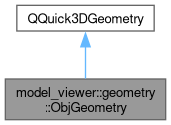
Inheritance diagram for model_viewer::geometry::ObjGeometry:
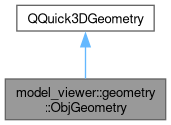
Collaboration diagram for model_viewer::geometry::ObjGeometry:
Public Member Functions | |
| ObjGeometry (QQuick3DObject *parent=nullptr) | |
| Constructor. | |
| void | setMesh (const std::vector< Vector3 > &vertices, const std::vector< Vector3 > &normals, const std::vector< TextureCoordinate > &textureCoords) |
| Set the mesh data. | |
Private Member Functions | |
| void | setModelData (const std::vector< Vector3 > &vertices, const std::vector< Vector3 > &normals, const std::vector< TextureCoordinate > &textureCoords) |
| Set the model data to the geometry. | |
| void | configureVertexLayout () |
| Configure the vertex layout of the geometry based on the data. | |
Private Attributes | |
| bool | _hasNormals = false |
| Whether the geometry contains normals. | |
| bool | _hasTextureCoords = false |
| Whether the geometry contains texture coordinates. | |
Detailed Description
Class representing the geometry of an OBJ model.
Constructor & Destructor Documentation
◆ ObjGeometry()
|
explicit |
Constructor.
- Parameters
-
parent Parent QQuick3DObject, nullptr by default
12: QQuick3DGeometry(parent) {}
Member Function Documentation
◆ configureVertexLayout()
|
private |
Configure the vertex layout of the geometry based on the data.
59 {
60 int stride = 3 * sizeof(float);
61 int offset = 0;
62 addAttribute(Attribute::PositionSemantic, offset, Attribute::F32Type);
63 offset += 3 * sizeof(float);
65 stride += 3 * sizeof(float);
66 addAttribute(Attribute::NormalSemantic, offset, Attribute::F32Type);
67 offset += 3 * sizeof(float);
68 }
70 stride += 2 * sizeof(float);
71 addAttribute(Attribute::TexCoord0Semantic, offset, Attribute::F32Type);
72 offset += 2 * sizeof(float);
73 }
74 setStride(stride);
75 setPrimitiveType(PrimitiveType::Triangles);
76}
bool _hasNormals
Whether the geometry contains normals.
Definition ObjGeometry.hpp:26
bool _hasTextureCoords
Whether the geometry contains texture coordinates.
Definition ObjGeometry.hpp:29
References _hasNormals, and _hasTextureCoords.
Referenced by setMesh().
Here is the caller graph for this function:

◆ setMesh()
| void model_viewer::geometry::ObjGeometry::setMesh | ( | const std::vector< Vector3 > & | vertices, |
| const std::vector< Vector3 > & | normals, | ||
| const std::vector< TextureCoordinate > & | textureCoords ) |
Set the mesh data.
- Parameters
-
vertices Vertices of the model normals Normals of the model textureCoords Texture coordinates of the model
16 {
17 clear();
18 _hasNormals = !normals.empty();
19 _hasTextureCoords = !textureCoords.empty();
20 setModelData(vertices, normals, textureCoords);
21 configureVertexLayout();
22 update();
23}
void setModelData(const std::vector< Vector3 > &vertices, const std::vector< Vector3 > &normals, const std::vector< TextureCoordinate > &textureCoords)
Set the model data to the geometry.
Definition ObjGeometry.cpp:25
void configureVertexLayout()
Configure the vertex layout of the geometry based on the data.
Definition ObjGeometry.cpp:59
References _hasNormals, _hasTextureCoords, configureVertexLayout(), and setModelData().
Here is the call graph for this function:
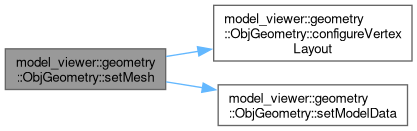
◆ setModelData()
|
private |
Set the model data to the geometry.
- Parameters
-
vertices Vertices of the model normals Normals of the model textureCoords Texture coordinates of the model
27 {
28 QByteArray vertexData;
29
30 const qsizetype vertexSize = static_cast<qsizetype>(vertices.size()) *
31 static_cast<qsizetype>(sizeof(Vector3));
32 const qsizetype normalSize = static_cast<qsizetype>(normals.size()) *
33 static_cast<qsizetype>(sizeof(Vector3));
34 const qsizetype textureSize =
35 static_cast<qsizetype>(textureCoords.size()) *
36 static_cast<qsizetype>(sizeof(TextureCoordinate));
37 vertexData.resize(vertexSize + normalSize + textureSize);
38 float *vertexDataPointer = reinterpret_cast<float *>(vertexData.data());
39 for (size_t i = 0; i < vertices.size(); ++i) {
40 const auto &[vx, vy, vz] = vertices[i];
41 *vertexDataPointer++ = vx;
42 *vertexDataPointer++ = vy;
43 *vertexDataPointer++ = vz;
45 const auto &[nx, ny, nz] = normals[i];
46 *vertexDataPointer++ = nx;
47 *vertexDataPointer++ = ny;
48 *vertexDataPointer++ = nz;
49 }
51 const auto &[u, v] = textureCoords[i];
52 *vertexDataPointer++ = u;
53 *vertexDataPointer++ = v;
54 }
55 }
56 setVertexData(vertexData);
57}
References _hasNormals, and _hasTextureCoords.
Referenced by setMesh().
Here is the caller graph for this function:

Member Data Documentation
◆ _hasNormals
|
private |
Whether the geometry contains normals.
Referenced by configureVertexLayout(), setMesh(), and setModelData().
◆ _hasTextureCoords
|
private |
Whether the geometry contains texture coordinates.
Referenced by configureVertexLayout(), setMesh(), and setModelData().
The documentation for this class was generated from the following files:
- /github/workspace/include/Geometry/ObjGeometry.hpp
- /github/workspace/src/Geometry/ObjGeometry.cpp
Generated by
 1.12.0